ما الذي تبحث عنه?

-
+8619376997331(وقت العمل)
-
summer@chinaxingheda.com(ارسل لنا عبر البريد الإلكتروني)
ما الذي تبحث عنه?
+8619376997331(وقت العمل)
summer@chinaxingheda.com(ارسل لنا عبر البريد الإلكتروني)
In Nokia AirScale indoor RAN architecture, the ASIA board serves as the first-generation system integration control card built for the AMIA 3U indoor subrack. Many field engineers and procurement teams frequently encounter ASIA during maintenance, spare replacement and legacy 4G/5G site renovation. Unlike capacity boards such as ABIA and ABIO that focus on user-plane baseband computation, ASIA undertakes core control-plane work to keep the entire BBU shelf operational.
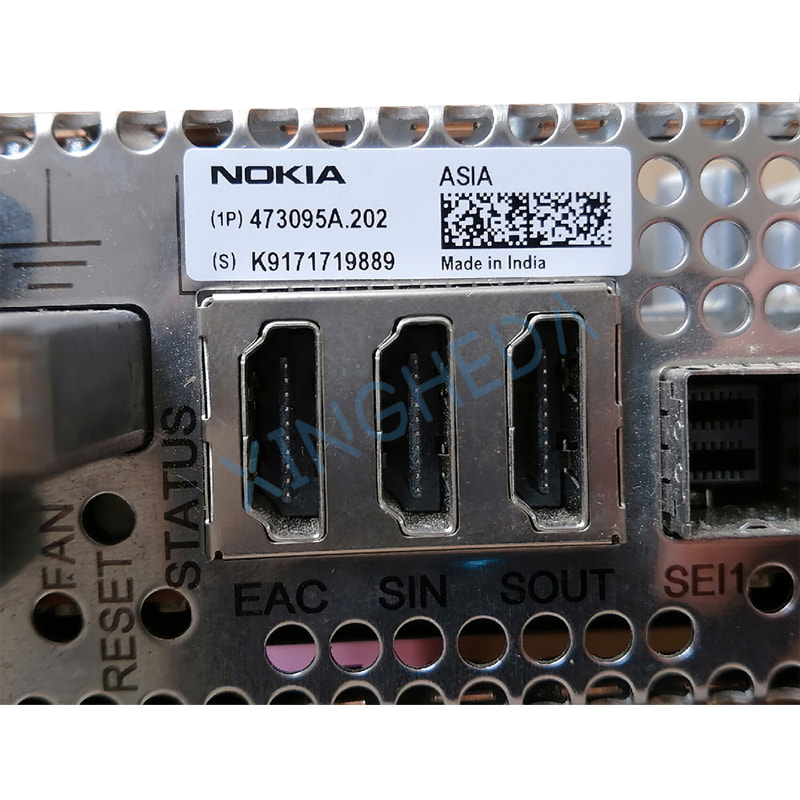
ASIA is installed in the dedicated C1/C2 control slots of the AMIA subrack. It delivers OAM management, subrack clock synchronization, inter-board signaling coordination, backhaul interface aggregation and fronthaul control toward remote radio units. Dual ASIA deployment supports active-standby redundancy, which greatly reduces single-point failure risk for critical macro sites. Without a valid ASIA board, capacity boards in the B slots cannot initialize, and the gNodeB or eNodeB will fail to come online even if the ABIA/ABIO modules are intact.
It mainly supports LTE and early-phase 5G NR deployments, working with AirScale radio series including ARHA, ARGA and ARDA RRU/RRH units over CPRI or eCPRI optical links. ASIA is widely used in existing urban macro stations, suburban coverage sites and indoor distributed systems. For operators running older AirScale releases, ASIA spare parts are essential for maintaining service continuity before full migration to newer control hardware.
As the predecessor of ASIB, ASIA shares the same control positioning but has different hardware revisions, supported software baselines and interface specifications. This is a key point that must be clarified during spare part selection. Direct replacement between ASIA and ASIB is not plug-and-play; software version matching and site configuration adjustment are mandatory to avoid alarms and link outages.
All board replacement should be carried out by certified technicians with proper ESD protection. Before hot-swap or power-off replacement, technicians need to record the original part number, hardware revision and running software release. After inserting the board, verify LED status via local indicators and pull alarm logs from the network management platform. Confirm board recognition, clock lock status and fronthaul link status before restoring cell services.
Q1: What is the core role of Nokia ASIA in the AMIA subrack?
A: ASIA is the first-generation AirScale system integration control board. It handles OAM, clock synchronization, inter-board signaling, backhaul and fronthaul control. It is the control core for the AMIA shelf, while ABIA and ABIO are capacity boards responsible for user-plane baseband processing. Capacity boards cannot run independently without a functional ASIA or ASIB control board.
Q2: Can I replace ASIA directly with ASIB without modifying site configuration?
A: No. ASIB is the upgraded successor of ASIA. Although both are control boards for AMIA, they differ in hardware revision, supported software release and interface logic. Direct swap will trigger version mismatch alarms, clock faults and cell outages. You need to check the official release matrix and complete software upgrade and parameter reconfiguration before replacement.
Q3: What radio units work with ASIA normally?
A: ASIA is designed to pair with AirScale remote radio units such as ARHA, ARGA and ARDA. It supports CPRI and eCPRI fronthaul. Compatibility still depends on the unified software baseline of the whole site, including the RRU firmware and subrack platform software. Mismatched RRU models or software versions will break fronthaul links.
Q4: Is dual ASIA deployment required for every AMIA site?
A: Not mandatory. Single ASIA can support basic site operation. Dual ASIA active-standby configuration is recommended for high-priority macro sites to implement redundancy protection. For low-traffic rural or temporary coverage sites, a single ASIA is commonly adopted to lower hardware costs.
Q5: What should I confirm before purchasing ASIA spare boards?
A: Confirm the original part number and hardware revision, the AMIA subrack version, the site’s running software release, slot planning and the paired RRU series. For refurbished stock, verify physical condition, connector integrity and test records. Visual similarity alone cannot guarantee compatibility.
2506 Xidi Building, No. 8 Fenglin Third Road,Yuelu District, Changsha City, Hunan Province


